
Anaximenes of Miletus
Pre-Socratic philosopher who held air as the fundamental substance.

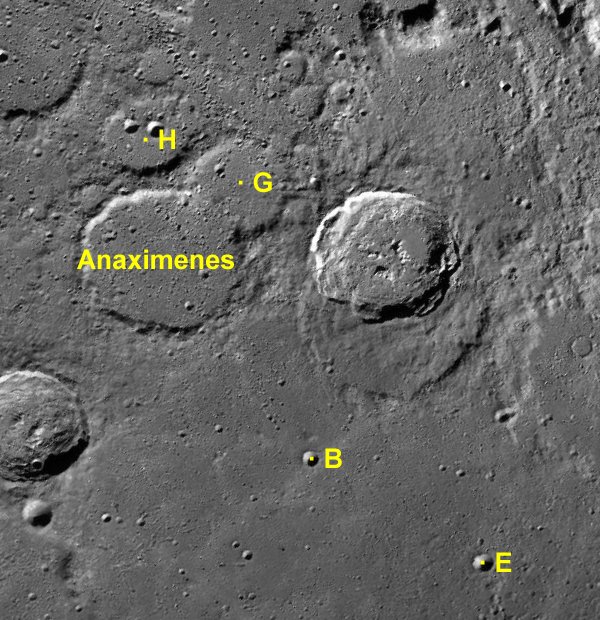
NASA / LRO_LROC_TEAM · Public domain
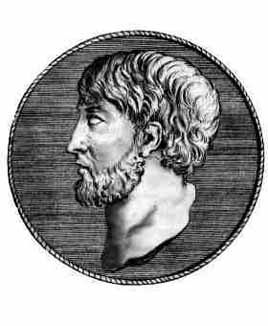
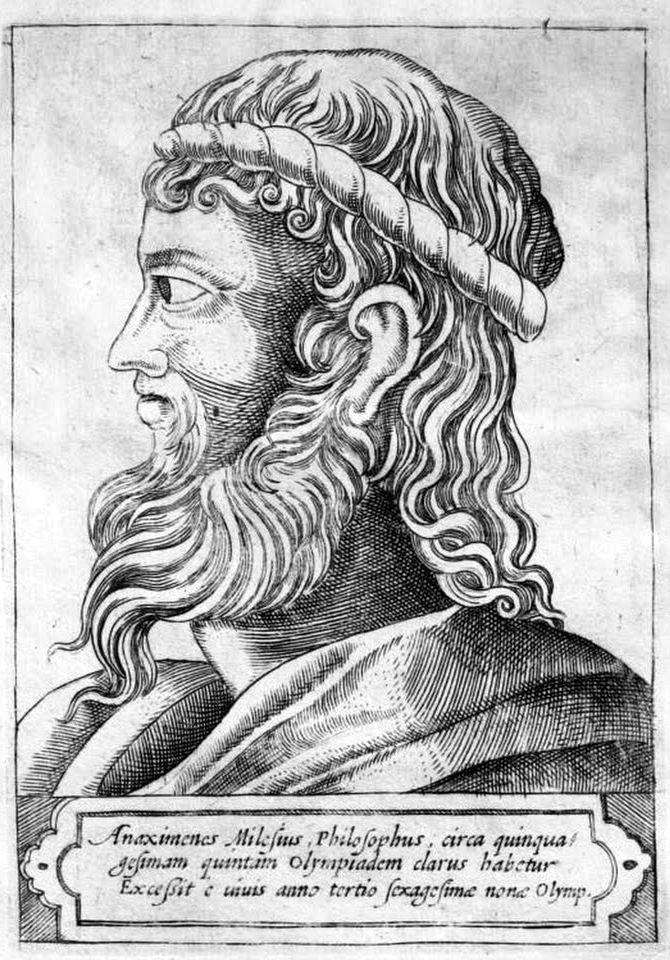
Anaximenes of Miletus was a pre-Socratic Greek philosopher from Miletus in Anatolia (modern-day Turkey). He was the last of the three philosophers of the Milesian School, after Thales and Anaximander, who are regarded by historians as the first philosophers of the Western world. Anaximenes is known for his belief that air is the arche, or the basic element of the universe from which all things are created.
- field
- Pre-Socratic philosophy
- nationality
- Greek (from Miletus, Anatolia)
- known_for
- Belief that air is the arche; theory of rarefaction and condensation; flat Earth model
Lore & Background
Little is known of Anaximenes's life and work, as all of his original texts are lost. Surviving information comes primarily from later writers, especially Aristotle and Theophrastus. According to Theophrastus, Anaximenes was the son of Eurystratus, an associate of Anaximander, and lived in Miletus. He was a student of Anaximander and likely also taught Homeric epics, Greek mythology, and Orphism. He is only known to have written one full text, possibly a response to Anaximander's On Nature, described as having a 'simple and economical Ionic style'.
Reader's Guide
Anaximenes is significant as the last of the three Milesian philosophers, who are regarded as the first philosophers of the Western world. His central contribution was the concept of air as the arche, from which all things arise through rarefaction and condensation. He developed an early model of the Earth as a flat disc floating on air, with the Sun and stars also flat and floating. He influenced many later Pre-Socratic philosophers, including Heraclitus, Anaxagoras, Diogenes of Apollonia, and Xenophanes. His work provided early examples of natural science, physical change, and scientific writing. Though often given lower importance than Thales and Anaximander in modern times, he was the preeminent Milesian philosopher in Ancient Greece. His ideas on temperature and density, while incorrect by modern science, represent an early attempt to connect observable phenomena to underlying principles.
Did You Know?
- Anaximenes believed that air could change into other forms through rarefaction or condensation, with condensation producing wind, clouds, water, earth, and stone.
- He described the Earth as a flat disc floating atop the air, with the Sun and stars also flat and floating alongside it.
- Anaximenes thought that the Sun revolves around the Earth, causing it to be obscured by higher lands during the night.
- He likened the soul to air, describing it as something driven by breath that wills humans to act.
The Milesian Triad
Anaximenes of Miletus occupies a distinctive position within what scholars recognize as the Milesian school, a small but foundational grouping of early Greek philosophers and natural inquirers. Alongside Thales and Anaximander, Anaximenes is named among the thinkers who made Miletus the birthplace of systematic philosophical and scientific thought in the Greek world. The city's role in this tradition was not incidental; rather, it served as the home base from which these three figures developed their inquiries, establishing a lineage of natural philosophy that would shape subsequent Greek intellectual life. What unites the trio is their shared Milesian origin and their collective contribution to the emergence of early Greek science and philosophy. The school's significance lies in its pioneering role in that development, a shift that Miletus, with its long history of cultural exchange and commercial vitality, was uniquely positioned to foster. Anaximenes, as the third named member of this group, represents the culmination of a local tradition of inquiry that began with Thales and continued through Anaximander.
The City as Intellectual Incubator
The material and economic conditions of Miletus created an environment in which sustained philosophical inquiry could take root. The city's wealth drew on its commanding position along the western Anatolian shore, close to where the Maeander River met the sea, a setting that sustained productive farming in the surrounding countryside and enabled extensive trade. This combination of agricultural output and maritime commerce generated the prosperity that allowed Miletus to function as a major center of culture and innovation spanning from the Bronze Age through the Roman period. Archaeological evidence, including the city's distinctive grid plan and the great sanctuary of Apollo at Didyma, testifies to a sophisticated urban culture with long-term planning and institutional investment. It was within this milieu of material abundance, organized civic life, and active engagement with the wider Mediterranean world that the Milesian school—Thales, Anaximander, and Anaximenes—emerged. The city's capacity to support such intellectual activity reflected centuries of accumulated cultural infrastructure, commercial networks, and the kind of stable, prosperous civic life that permits citizens to pursue questions beyond immediate material need.
A Crossroads of Civilizations
Anaximenes worked in a city that was, by any measure, a point where multiple cultural traditions overlapped and interacted. Miletus sat at the intersection of Greek, Anatolian, Persian, and Roman spheres of influence, experiencing alternating periods of autonomy and foreign rule throughout its long history. Its earliest layers of settlement show Minoan and Mycenaean connections, with trade artifacts arriving from Crete by around 1900 BC and the city later serving as a Mycenaean stronghold on the Asian coast. Hittite records document diplomatic and military interactions with the city, while Homer places Miletus among the allies of Troy during the Trojan War, identifying it as a Carian city. The Ionian League, of which Miletus was a member among twelve city-states, further wove it into the broader Greek political fabric. This layered, multicultural heritage—Cretan, Mycenaean, Hittite, Carian, Ionian, Persian, Roman—meant that the intellectual life of Miletus, including the work of its Milesian philosophers, developed in a context far richer and more cosmopolitan than a single ethnic tradition might suggest.
Miletus and the Wider Greek World
The influence of Miletus extended far beyond its own walls, and the ideas associated with its thinkers, including Anaximenes, circulated through a network that shaped the entire Greek world. Miletus planted dozens of colonial settlements around the Mediterranean and Black Sea, a process that profoundly shaped how Greek civilization spread across the ancient world. Its ties with other Greek polities were deep and longstanding: the city maintained early connections with Megara, possibly forming a colonisation alliance, and forged an enduring alliance with Athens that would play a significant role during the Persian Wars. Miletus was also involved in the Lelantine War of the eighth century BC, demonstrating its active participation in the political and military affairs of the Greek world. Through these colonial, diplomatic, and military channels, the cultural and intellectual output of Miletus—its philosophy, its urban planning innovations, its scientific inquiries—found audiences and resonances across the Aegean and beyond. Anaximenes, as a product of this Milesian tradition, was embedded in a network of exchange that ensured his ideas were not confined to a single coastal city but participated in the broader currents of Greek thought.
Gallery

Frequently Asked Questions
What is Anaximenes of Miletus's central philosophical claim?
He argued that air is the arche, the single underlying substance from which everything in the cosmos originates. All other elements and living things, in his view, derive from transformations of this one fundamental stuff.
How does Anaximenes of Miletus explain the diversity of the natural world?
He proposed a mechanism of rarefaction and condensation: when air thins it becomes fire, and as it thickens it passes successively through wind, cloud, water, earth, and stone. This single process accounts for every material change he could observe.
Why is Anaximenes of Miletus considered important in the history of philosophy?
As the last of the three Milesian thinkers, he completed the early Greek attempt to explain nature through a single natural principle rather than myth. His work set the stage for later pre-Socratic debates about the fundamental substance of reality.
More in Ancient And Medieval Historians And Philosophers 1-18
Spotted an error? Know more?
This is a living reference — every entry is fact-audited, and reader corrections feed straight into our audit queue. Suggest an edit · See this site's audit record