
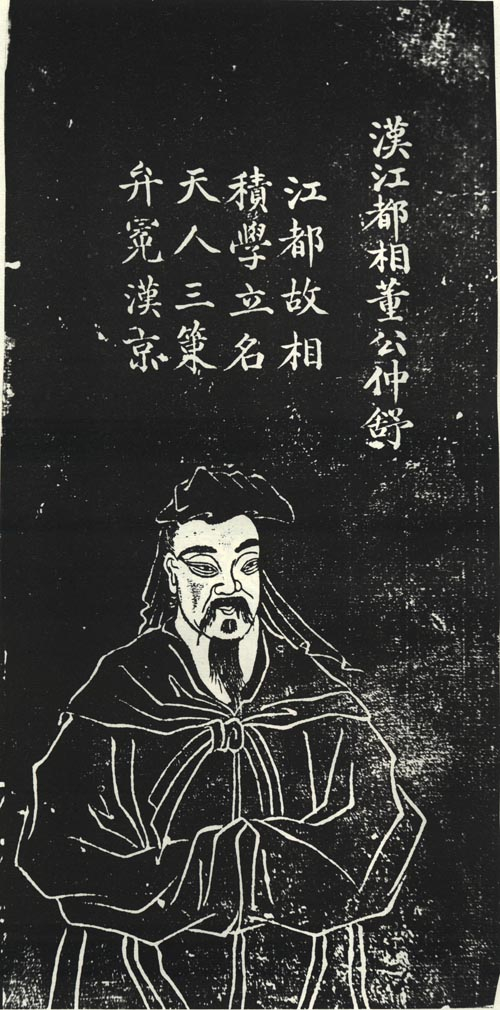
Dong Zhongshu
Han dynasty philosopher who promoted Confucianism as state ideology.

via Wikipedia: Laozi · see source
He is traditionally associated with the promotion of Confucianism as the official ideology of the Chinese imperial state, favoring heaven worship over the tradition of cults celebrating the five elements. His teachings, transmitted from his later post in the Chancellery of Weifang, exerted lasting influence on Chinese political thought.
- field
- Philosophy, politics, writing
- nationality
- Chinese (Han dynasty)
- known_for
- Promotion of Confucianism as state ideology; doctrine of Interactions Between He
Lore & Background
At one point he was thrown into prison and nearly executed for writings considered seditious, which may have cosmologically predicted the overthrow of the Han dynasty and its replacement by a Confucian sage.
Reader's Guide
Dong Zhongshu's significance lies in his role in elevating Confucianism to the official ideology of the Chinese imperial state, a shift that shaped Chinese governance for centuries. He is considered the originator of the doctrine of Interactions Between Heaven and Mankind, which provided rules for monarchical legitimacy and checks on royal power. His concept of 'three heritages' held that a new king must preserve the heritage of two earlier kings to maintain continuity.
Did You Know?
- Dong Zhongshu was once thrown into prison and nearly executed for writings considered seditious, which may have cosmologically predicted the overthrow of the Han dynasty.
- He was banished to the Chancellery of Weifang by Emperor Wu's chief counselor Gongsun Hong, which effectively forced his partial retirement.
- The main text attributed to him, the Luxuriant Dew of the Spring and Autumn Annals, is now regarded by scholars as a collection of unrelated or loosely related chapters written by multiple authors at different times.
- His concept of 'three heritages' held that a new king must preserve the heritage of two earlier kings to maintain continuity.
- His theories on 'original qi', the five elements, and historical development were later adopted and modified by the late Qing reformer Kang Youwei.
Gallery



Frequently Asked Questions
Who is Dong Zhongshu?
Dong Zhongshu (179–104 BC) was a Han dynasty Chinese thinker, statesman, and author. He is most remembered for persuading the imperial court to embrace Confucianism as the guiding ideology of the state.
What is Dong Zhongshu's main philosophical contribution?
He fused Yin Yang cosmological concepts into the Confucian ethical tradition, producing a unified framework for understanding nature and human conduct. His doctrine of Interactions Between Heaven and Mankind remains his most cited theoretical innovation.
How did Dong Zhongshu shape Han dynasty governance?
He lobbied the Han court to make Confucianism the official state philosophy, fundamentally altering the intellectual basis of imperial rule. His administrative work out of the Chancellery of Weifang helped embed those Confucian principles into day-to-day governance.
What does the doctrine of Interactions Between Heaven and Mankind say?
It holds that Heaven and human affairs respond to one another, so that an emperor's virtue or failings will manifest in natural phenomena. This gave rulers a cosmic accountability while simultaneously sacralizing the throne.
Why is Dong Zhongshu still studied by fans of ancient philosophy?
His synthesis of cosmology, ethics, and statecraft became the backbone of Chinese political thought for centuries after his death. His choice to elevate heaven-centered worship over five-element cults also permanently redirected the empire's philosophical priorities.
More in Ancient And Medieval Historians And Philosophers 1-18
Spotted an error? Know more?
This is a living reference — every entry is fact-audited, and reader corrections feed straight into our audit queue. Suggest an edit · See this site's audit record